Tools for Change based on Jewish Spirituality
I'm an artist, an educator, and — maybe most of all — a learner. The thing I keep discovering, over and over, is that I understand something best once I've built a way to hold it: a tool, a guide, a workbook, a practice I can return to and hand to someone else. That’s why I’ve built these things. To help me — and maybe you — learn better.
Some of these are study companions for specific holidays or texts. Some are practices meant to be lived through over weeks, alone or with a whole community. All of them came out of real study, real facilitation, real trial and error — and all of them are still alive, which means they'll keep changing as I do.
Please use them. Adapt them, bring them into your own communities, make them yours. That's what they're for.
And if something here was useful to you — I'd love to hear about it. Tell me what you tried, what it opened up, what you'd change. If you share it further, attribute it back to me. And if you're able, pay for it what you can. These take real time and real care to make, and your support helps me keep making and sharing them.
Between the Narrow Places
STUDY GUIDE FOR TISHA B’AV
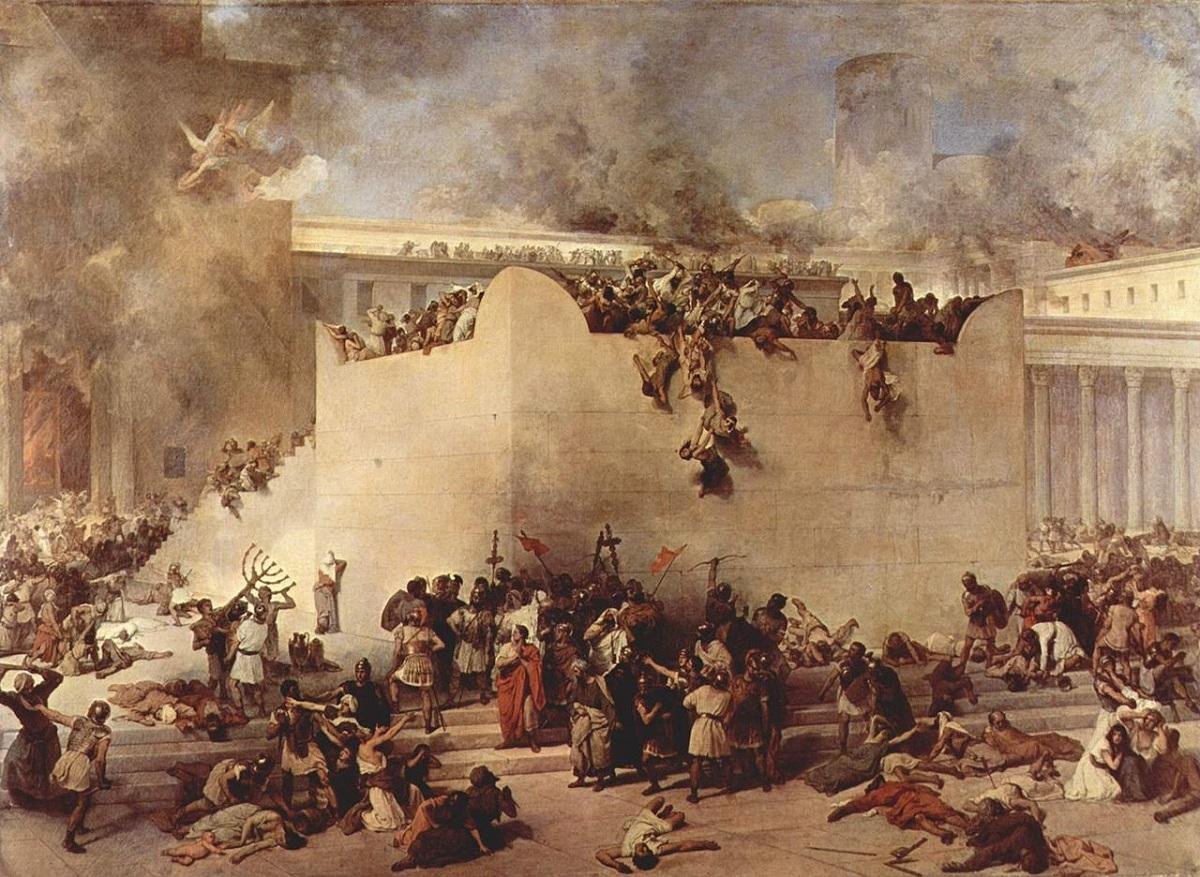
The destruction of the Temple of Jerusalem. Francesco Hayez (1791–1882)
This is a study guide built to take us through the Jewish calendar's own architecture for collective mourning. The arc follows Bein HaMetzarim, the Three Weeks between the seventeenth of Tammuz and the ninth of Av: three weeks of descent, a single concentrated day of rupture at Tisha B'Av, and seven weeks of comfort that follow.
The course draws a direct line from ancient catastrophe to the grief many of us are carrying now — including, unavoidably, the devastation in Gaza and the long reckoning many Jews are doing with Zionism.
Each session pairs a primary text (Eicha / Lamentations, relevant Talmud and Midrash) with contemporary texts and a writing prompt that helps us reflect on how these texts are alive for us today, how and what we are mourning and why it matters.
This guide can be used alone or with a group.
Tanakh Character Study Tool
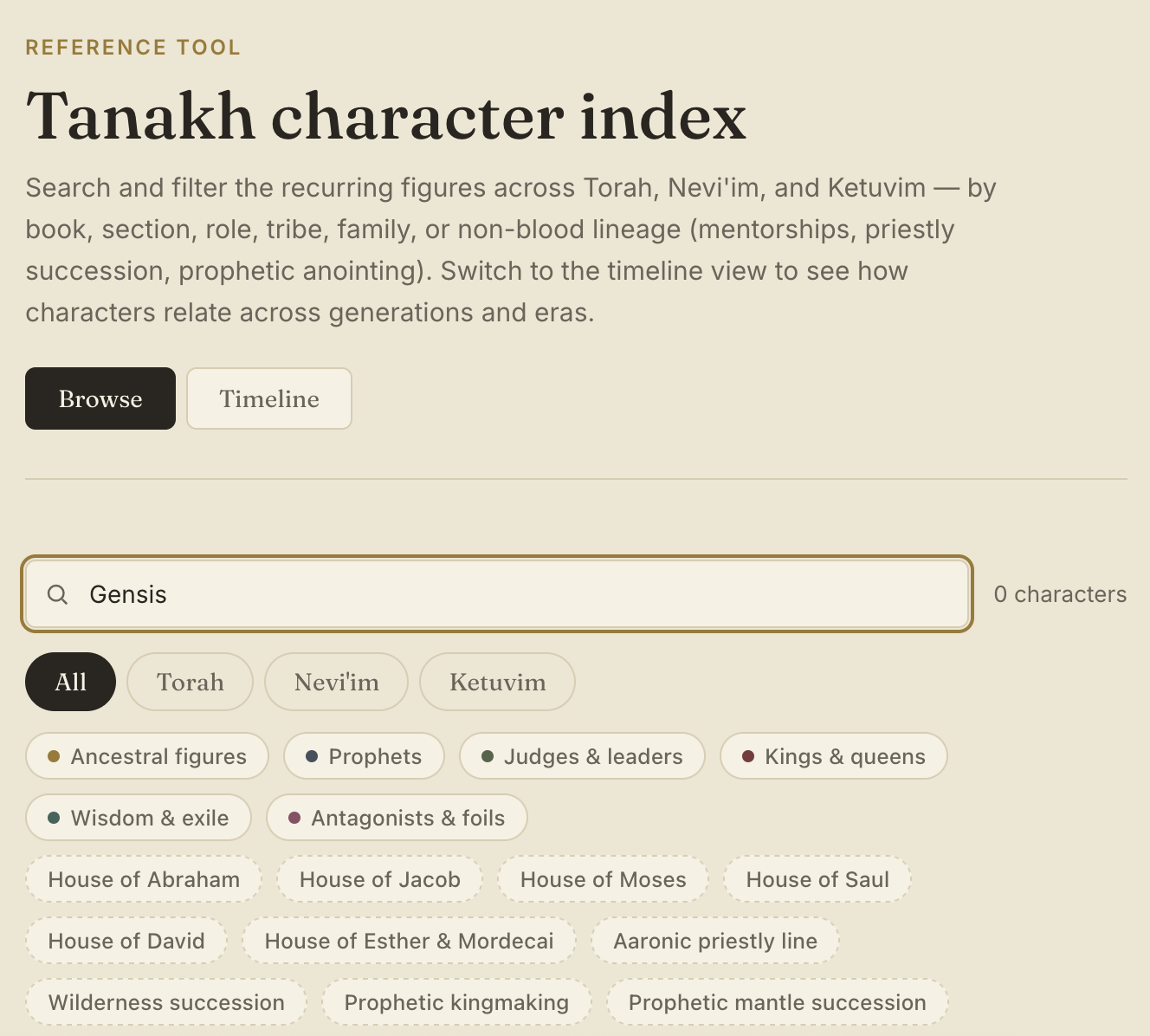
This is a study companion for holding the Tanakh's recurring characters in relationship to each other — who's a contemporary of whom, which tribe and family someone belongs to, and which threads run underneath the obvious ones.
It includes fifty-some figures, six eras and just one search bar!
Some of those threads are blood: the house of Jacob, the house of David, the Aaronic priestly line splitting into rival branches at Eli's fall and Zadok's rise. Others aren't blood at all — Elijah passing his mantle to Elisha, Samuel anointing both of Israel's first kings, the echo between Saul's unfinished war with Amalek and Haman's descent from Agag centuries later. I’ve also included the outsider women — Hagar, Tamar, Rahab, Ruth, Zipporah — who I see just as much a part of the story.
Counting of the Omer
A PRACTICE FOR GROUPS, ORGANIZATIONS & COLLECTIVES
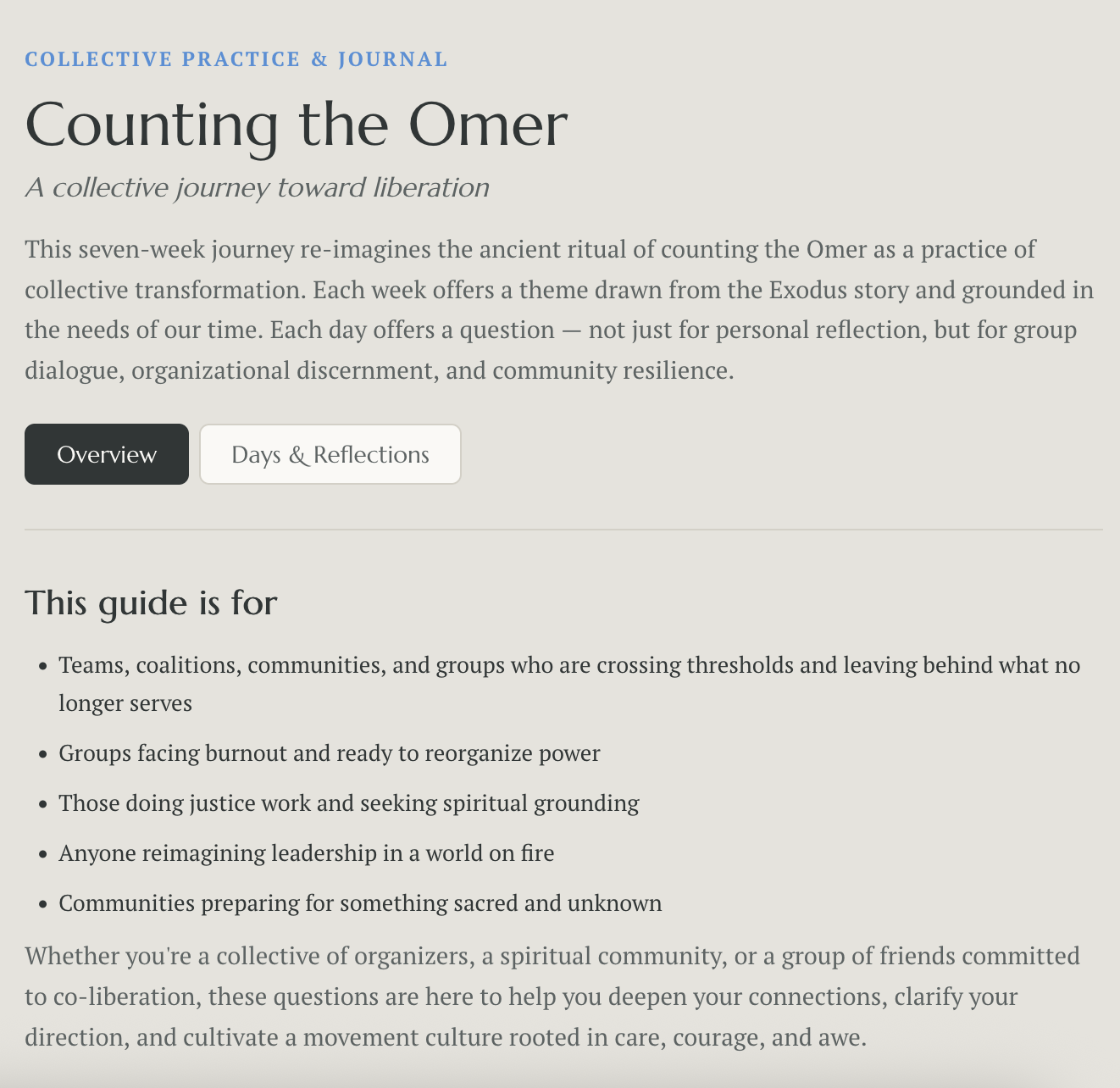
The Omer is the count of forty-nine days between Passover and Shavuot — between the exodus from Egypt and the revelation at Sinai. Traditionally it's counted alone, one person marking each night, a private discipline of anticipation. This guide keeps the arc but changes who's doing the counting: instead of an individual counting toward their own readiness, it's built for teams, coalitions, and communities counting together toward theirs.
Each of the seven weeks takes a beat from the Exodus story — the sea crossing, the bitter water made sweet, manna and its limits, water struck from rock, the ambush by Amalek, Jethro's warning about doing too much alone, the trembling approach to Sinai — and asks what that beat means for a group rather than a single soul. The two questions each day aren't abstract: they're built to be brought into a meeting, a check-in, a retreat, asked aloud and answered by more than one voice.
It's meant for exactly the kind of group that's crossing a threshold, burning out, or trying to lead without replicating the harm it's organizing against — coalitions leaving behind what no longer serves, communities relearning how to share power, anyone trying to build a movement culture rooted in care as much as urgency. The questions aren't dogma. They're invitations, meant to be adapted, remixed, and handed to whoever needs them next.
Book an Exploratory Session
Let’s get to know each other and see where our mystery may lead. I offer 30 minute consultations to prospective coaching, consulting clients and partners.